Best Group Adventures in Colorado for Friends and Teams
Getting a group to agree on dinner is difficult enough. Someone’s gluten-free, someone only eats at places with a view, and someone just wants tacos and won’t budge. Now multiply that by ten. Planning an actual adventure for ten, twenty, or fifty people is a different level of difficult entirely, and if you’ve ever been the one holding the group chat together, you already know it.
Somebody in the group wants adrenaline, the bigger the rapid or the steeper the trail, the better. Somebody else has never done anything like this before and is quietly hoping nobody notices they’re nervous. A few people are only mildly outdoorsy and are hoping the itinerary doesn’t get too ambitious. Someone is going to ask how long the whole thing takes, because they’ve got a flight to catch that evening. Someone else is going to ask where everyone’s sleeping, because they’re already picturing a dozen coworkers crammed into one cabin arguing over bunks. If you’ve ever tried to plan a bachelorette weekend, a company retreat, or a family reunion that involves more than a group text, you know exactly how fast “let’s do something fun together” turns into a full-blown logistics problem.
That’s the real challenge with group adventures in Colorado. It’s not finding something to do, the state is bursting with options in every direction you look. It’s finding the one thing an entire group can do together, at the same time, in the same place, without half of them standing around bored while the other half has all the fun.
Why Rafting Works Better Than Almost Anything Else
This is where whitewater rafting quietly solves a problem that most other group activities can’t.
Think about how most outdoor group activities actually play out. On a hike, the fast walkers get way ahead within the first ten minutes and the group splits into little clusters, everyone experiencing the day separately, half a mile apart, out of earshot. On a climbing trip, one person is on the wall while everyone else stands around at the base holding a rope, snacking, checking their phones, waiting their turn. On a ropes course, people get shuffled through in small groups while the rest of the crowd watches from the ground. Even something as simple as a bike ride tends to string a group out across a trail, the fast riders up front, everyone else trailing behind, and by the time you regroup at the end, you’ve barely spoken to half the people you came with.
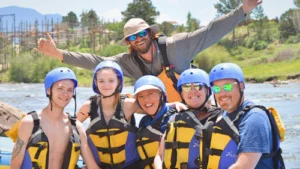
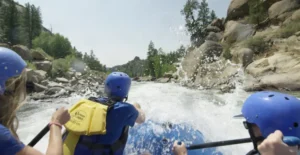
Rafting doesn’t work like that, and once you’re actually on the water, you feel the difference immediately. Everyone in the boat is paddling at the same time. Everyone hits the same rapid at the same second, feels the same jolt of cold spray in their face, lets out the same yell when the raft drops into a trough and climbs back out the other side. Nobody is standing on the shore waiting for a turn, and nobody gets left behind because they’re not as fast or as fit as the person next to them. For a few hours, the whole group is doing the exact same thing, in the same boat, at the same moment, reacting to the same river, and that’s a rarer setup than it sounds.
It also delivers something a lot of forced team-building exercises try and fail to manufacture. There’s real teamwork required to get a raft through a rapid clean, paddling in sync, listening for the guide’s call over the roar of the water, digging in together the instant the boat hits a wave wrong. But it doesn’t feel like a corporate exercise somebody dreamed up on a whiteboard. It feels like an actual shared experience, because it is one. Nobody’s rolling their eyes at a trust fall or a name game. They’re gripping a paddle, trying to keep the raft pointed the right direction through Zoom Flume or Seidel’s Suckhole, and somewhere in the middle of that adrenaline, the group actually starts operating like a team without anyone ever using the word “team-building” out loud.
Then there’s the part that matters most for how the trip gets remembered afterward: rafting gives everyone the exact same story. A group that splits up for the afternoon comes back with five different versions of the day, stitched together secondhand over drinks. A group that rafts together comes back with one story that every single person actually lived through, the same rapid, the same near-miss, the same moment somebody went overboard, got hauled back in soaking and laughing, and immediately became the trip’s main character. That’s the thing people bring up at dinner that night. It’s the thing they’re still talking about a year later, the story that gets retold every time the group is back together, usually with the details getting a little bigger each time.
What It Actually Feels Like
Picture the scene for a second. Twelve people who work together but barely talk outside of Slack are standing on a gravel riverbank in wetsuits, holding paddles they don’t quite know how to use yet, listening to a guide explain what “forward paddle” and “get down” actually mean when it counts. Nobody’s confident. A couple of people are visibly nervous. One person is already asking if there’s a bathroom nearby.
Twenty minutes later, that same group is barreling through a rapid, paddles digging in together, someone’s hat is gone forever, somebody in the back is screaming half in fear and half in pure joy, and the boat punches through the wave and comes out the other side soaked and intact. For a second, everyone just looks at each other. Then somebody laughs, and then everyone’s laughing, and just like that, twelve coworkers who barely talked an hour ago are a group that shares an inside joke about the guy who lost his hat in Zoom Flume.
That’s the transformation rafting produces, reliably, trip after trip. It’s not a manufactured icebreaker. It’s twenty minutes of genuine adrenaline that does more for group dynamics than a full day of scheduled activities ever could.
What to Consider Before Booking
None of this works if the trip is chosen without thinking about who’s actually in the group. A few questions are worth answering honestly before booking anything.
How wide is the range of experience and comfort levels? A group of thirty coworkers is very different from a group of eight lifelong friends who’ve all rafted together before. If half the group has never been on a river and the other half is hoping for real whitewater, look for an outfitter who can either split the group across trips of different intensity or recommend a stretch of river with enough excitement for the adventurous crowd without overwhelming anyone new to it. Browns Canyon on the Arkansas River is a strong middle ground for exactly this reason: real rapids, genuinely thrilling, but manageable for first-timers with a solid guide calling the shots.
How much time does the group actually have? A half-day trip delivers the shared adrenaline and the shared story without eating up an entire vacation day, which matters a lot for corporate retreats and any group with people flying in and out on tight schedules. A full-day trip works better when adventure is the whole point of the visit rather than one piece of a bigger itinerary, and it gives the group longer on the water to really settle into the rhythm of paddling together.
Where is everyone staying, and how does the group get to and from the river? This is the detail that gets overlooked until the week before the trip and then suddenly becomes everyone’s problem. Larger groups need lodging that can actually hold everyone under one roof, or at least close together, and transportation to the put-in point that doesn’t turn into its own logistical headache with three different cars going three different directions. Working with an outfitter who can coordinate shuttles and has relationships with nearby lodging saves a huge amount of last-minute scrambling, and it means the person who organized the trip actually gets to enjoy it instead of spending the whole time on the phone.
Is this a one-day activity, or part of something bigger? For groups planning a longer trip, rafting works well as the anchor around which the rest of the days are built. If your group has the time for it, a multi-day trip can combine rafting with other activities so the group gets both the shared adventure and enough downtime that nobody burns out by day two, which matters more than people expect once the second consecutive early wake-up call hits.
The Real Takeaway
Planning something an entire group will genuinely enjoy is hard, mostly because groups are made up of people who all want different things, different pace, different intensity, different comfort with the unknown. But the activities that work best for groups aren’t the ones with the most options on the menu or the biggest adrenaline spike for the boldest person in the crowd. They’re the ones that keep everyone in the same boat, literally, at the same time, feeling the same rapid under them.
That’s the case for rafting as a group adventure in Colorado. It doesn’t split the group up. It doesn’t leave anyone standing on the shore watching someone else have the fun. It takes people who barely know each other, or who’ve known each other forever but rarely do anything memorable together anymore, and gives all of them the same twenty minutes of adrenaline, the same soaked clothes, the same story to tell for years. At the end of the day, that’s usually the whole point of getting the group together in the first place, and it’s why so many friends, teams, and families who plan a Colorado trip end up on the river before anything else.